Up to $130,000 in tax savings. A one-year window. A policy announcement big enough to shift how Ottawa buyers think about what to buy next.
Ontario's 2026 provincial budget, tabled on March 26, removes the full 13% Harmonized Sales Tax (HST) on new homes valued up to $1 million — for all buyers, not just first-timers. This isn't a rebate you apply for after closing. Starting April 1, 2026, builders simply don't charge the HST on qualifying agreements. The savings come off your purchase price directly.
But before you abandon your resale search and pivot entirely to new construction, there's a second half of this story that deserves equal attention: Ontario's new home construction sector is under severe strain. Labour shortages, permitting backlogs, and rising development costs have pushed the province's 2026 housing start projections to their lowest revised level in years. The tax incentive is real. The supply to absorb it is not.
For Ottawa buyers, understanding both sides of this policy is the difference between making a smart move and chasing a headline.
📥 Download our free First-Time Buyer Guide
Everything you need to know about buying in Ottawa — from mortgage pre-approval to closing day. [Download our Home Buyer Guide]
What Is the Ontario New Home HST Rebate — and How Much Can You Actually Save?
Ontario's 2026 budget removes the full provincial portion of the HST (8%) — and the federal government is covering its 5% share too — on newly constructed homes valued up to $1 million, for agreements of purchase and sale signed between April 1, 2026 and March 31, 2027. This applies to all buyers: first-time buyers, move-up buyers, downsizers, and investors purchasing long-term rental properties.
On a $900,000 new build, the combined savings are $117,000. At $1,000,000, $130,000. These figures are available to every qualifying buyer during this one-year window — not just first-timers.
First-time buyers have an additional layer available to them: the separate permanent federal FTHB GST rebate, which received Royal Assent on March 12, 2026, applies for purchases outside this window and can stack for eligible buyers during it. But the $130,000 headline figure during April 2026–March 2027 is for everyone.
| Price Point | Full HST Removed (All Buyers) | Max Savings |
|---|---|---|
| $600,000 | $78,000 | $78,000 |
| $800,000 | $104,000 | $104,000 |
| $1,000,000 | $130,000 | $130,000 |
| $1,000,001–$1,500,000 | $130,000 flat | $130,000 |
| $1,500,001–$1,850,000 | Sliding scale | Down to $24,000 |
| Above $1,850,000 | $24,000 | $24,000 |
One important detail on eligibility: the home must be purchased as a primary residence or a long-term residential rental property. The agreement must be signed on or after April 1, 2026. Talk to your real estate lawyer before signing to confirm eligibility — the conditions are specific and the savings are too large to assume.
We have already had this conversation with several Ottawa buyers this week. The savings are real and worth taking seriously — but so is the fine print.
Does This Mean Ottawa Buyers Should All Be Looking at New Builds?
The short answer is: not necessarily — and here is why.
The rebate creates genuine financial incentive. But incentive is only useful if there is supply to match it. Right now in Ontario, there is not.
Ontario's 2026 budget projects just 64,800 new housing starts this year — 10,000 fewer than the province expected at this point, and 30,000 fewer than what the 2024 plan called for. That number has been revised downward three consecutive times. Ontario's Finance Minister has described the province's 1.5 million homes by 2031 target as now a "soft" goal.
While the federal government has pledged to double the pace of homebuilding, the on-the-ground reality points to stagnant or dwindling housing starts in many communities, particularly in Ontario.
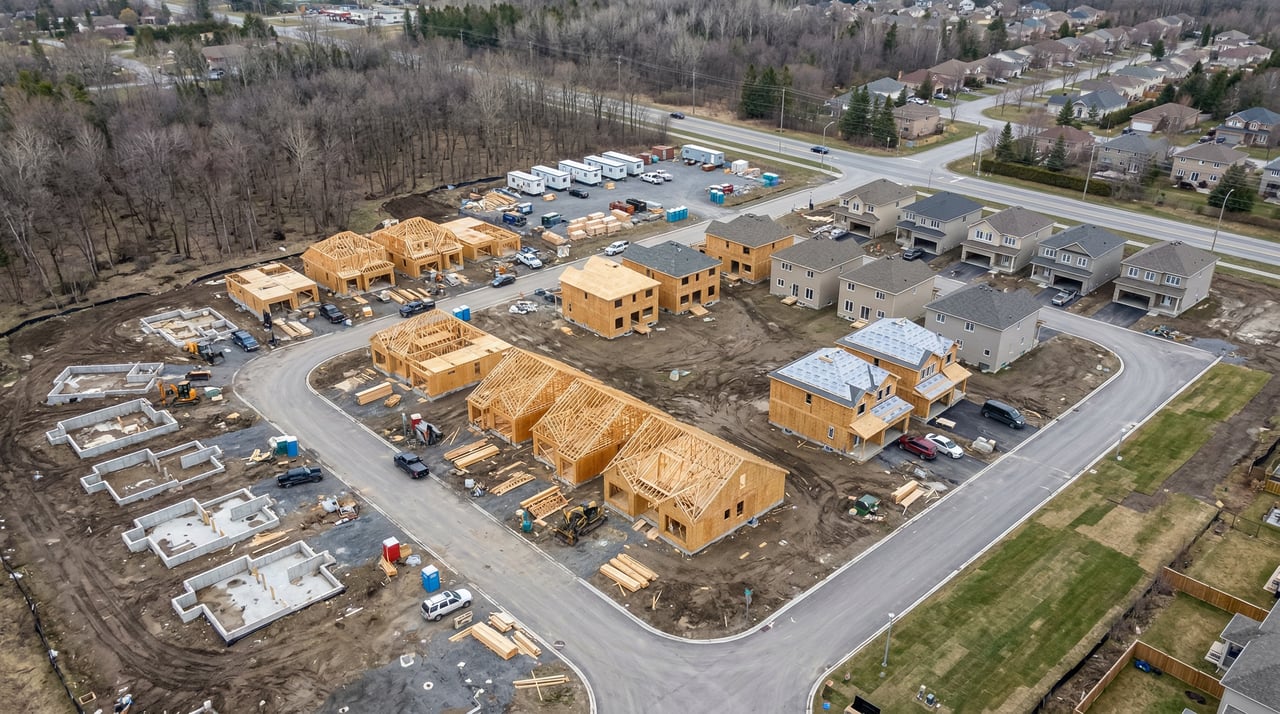
For Ottawa buyers, this matters in a very practical way. The new builds that qualify for the April 2026 to March 2027 rebate window need to already be in the pipeline. Homes where construction hasn't started won't be delivered in time. Inventory that qualifies — meaning units available under a builder agreement signed within the window, under $1 million, for primary residence or rental use — is limited.
In Ottawa's suburbs, new low-rise builds in Barrhaven, Riverside South, Stittsville, and Kanata North tend to fall within the $700,000 to $950,000 range, which qualifies. But developer inventory in those communities is not unlimited. We are already tracking which builders have qualifying units available, and in several projects, phase releases are moving quickly since the announcement.
The rebate does not create new homes. It creates urgency around existing pipeline inventory.
Why Is Ontario Building So Few New Homes If Demand Is This Strong?
The construction slowdown is not a mystery — it is the result of several compounding pressures that a tax rebate alone cannot solve.
Labour shortages. BuildForce Canada forecasts that Ontario will require roughly 154,100 additional construction workers by 2034 to meet planned infrastructure and housing needs. The industry is already stretched thin, facing the rising costs of borrowing, a tight labour supply, complex regulatory requirements, and material inflation — all of which have suppressed starts even when approved projects were ready to proceed.
Permitting backlogs. In Toronto, average approval times for housing projects reached 32 months in 2022 and the problem has not fully resolved. Ottawa's timelines are shorter, but the city is not immune to the challenge of matching planning approvals with actual shovels in the ground.
Development costs. Ontario's builders struggle to keep prices down due to increased input costs, including some of the highest municipal development charges in the country. Development charges — the fees municipalities impose on builders to fund infrastructure — can add $100,000 or more to the cost of a new home before construction even begins.
The condo problem. New home sales across Ontario fell to approximately 15,000 units in 2025, down from historic annual levels of 65,000 to 85,000 units. Ontario's sluggish construction market has already begun triggering job losses in the trades. The GTA condo pipeline — which historically drove a significant share of Ontario starts — has been gutted by years of slow pre-construction sales.
The honest assessment: a one-year HST removal cannot rebuild a trade workforce, streamline municipal approvals, or cut development charges. The Ontario government estimates the rebate will result in approximately 8,000 additional housing starts annually. Even if that proves accurate, it is a fraction of what the province needs, and it arrives slowly.
What Does the HST Rebate Mean for Ottawa's Resale Market?
Here is the question we are getting from sellers and buyers alike: does this shift demand away from resale homes and toward new construction?
Partially — but less than the headlines suggest, for three reasons.
First, the qualifying inventory is narrow. The rebate applies to new builds under $1 million, signed April 1, 2026 to March 31, 2027, for primary residence or rental use. A significant share of Ottawa's new home market falls within this range, but available inventory in that window is not unlimited. Many buyers will research the rebate, discover that qualifying new builds in their preferred area are sold out or years from delivery, and return to the resale market.
Second, new builds carry their own costs. Even with the HST removed, new construction typically comes with higher baseline prices, longer closing timelines — sometimes two to three years for low-rise homes — occupancy fees during interim possession, and Tarion warranty enrollment fees. Tarion — the Ontario new home warranty program — provides protection on new builds, but buyers should understand its coverage limits and the claims process. The rebate removes the HST, not every other variable cost of buying new.
Third, resale inventory in Ottawa has solid selection right now. Ontario's well-supplied resale market is actually one of the factors constraining new construction starts — buyers have good options at multiple price points without committing to long timelines. Buyers who need to move in the next six to twelve months, or who have specific neighbourhood preferences that new construction doesn't serve, have a strong case for resale.
Our view: the HST removal will pull some buyers toward new construction who were borderline on affordability. For those buyers, the savings are meaningful and worth pursuing. For most Ottawa buyers — particularly those with specific neighbourhood needs, shorter timelines, or who are buying into an established community — the resale market remains the more practical path.
What Should Ottawa Buyers Actually Do Right Now?
If you are actively looking, or thinking about starting your search in 2026, here is how to think about this practically.
If you're buying a new build: You qualify for the full HST removal regardless of whether this is your first home. Up to $130,000 in savings, applied at the point of sale. Talk to your real estate lawyer before signing a builder agreement to confirm eligibility, and move now — the window is real and inventory is responding to the announcement.
If you're a first-time buyer: Everything above applies, plus you may have access to the separate permanent federal FTHB rebate for future purchases outside this window. The stacking potential is significant. Work with your mortgage broker to understand the full picture.
If you're a repeat buyer or investor: The full savings are available to you during this window. You're weighing that against new build timelines, occupancy fees, and whether a resale home gets you what you actually need faster.
If you're a seller: Don't panic. The buyers shifting to new builds were, in most cases, buyers for whom new construction was already a possibility they were weighing. The buyers who want your neighbourhood, your lot size, your property type, or your possession timeline — those buyers are still in the resale market, and right now they have improving mortgage rate conditions supporting their purchasing power.
We help buyers in Ottawa evaluate both paths honestly — not based on what headlines suggest you should do, but based on your specific situation, timeline, and the actual inventory available to you.
Frequently Asked Questions About Ontario's New Home HST Rebate
Q: How much can Ontario buyers save with the 2026 HST rebate on new homes?
A: All buyers of qualifying new homes in Ontario can save up to $130,000 during the one-year window from April 1, 2026 to March 31, 2027. The full 13% HST is removed at the point of sale on homes valued up to $1 million — the federal government is covering its 5% share for all buyers during this period. You don't apply for it after closing; builders simply don't charge it on qualifying agreements.
Q: Is the Ontario HST rebate only for first-time buyers?
A: No. The 2026 one-year program applies to all buyers — first-time buyers, move-up buyers, downsizers, and investors purchasing long-term rental properties. This is the most important thing most news coverage is getting wrong. First-time buyers also have access to a separate permanent federal FTHB rebate for purchases outside this window, but the $130,000 savings during April 2026–March 2027 is available to everyone.
Q: Does the Ontario HST rebate apply to resale homes?
A: No. The Ontario new home HST removal applies only to newly constructed homes sold by a builder — not to resale properties purchased from a previous owner. HST is not charged on private resale home sales in Ontario. The policy is specifically designed to stimulate new construction.
Q: Will Ontario actually build enough new homes to meet the demand this rebate creates?
A: The province projects approximately 64,800 new housing starts in 2026 — a number revised downward three consecutive times. Ontario estimates the rebate will stimulate roughly 8,000 additional starts annually. Labour shortages, permitting timelines, and high development charges all constrain builders' ability to respond quickly to demand increases. Most housing analysts expect supply to remain the binding constraint.
Q: Is Ottawa's new build market strong enough for me to find a qualifying home?
A: Ottawa's suburban new home market — particularly in communities like Barrhaven, Riverside South, Kanata, and Stittsville — offers meaningful selection of homes priced under $1 million that qualify for the rebate. However, inventory in active communities is moving quickly since the announcement. We track current new build availability across Ottawa and can help you identify what's actually available within the rebate window.
Q: How does the Ontario HST rebate interact with Ottawa's resale market?
A: The rebate will redirect some buyers toward new construction. However, the limited supply of qualifying new builds, longer timelines to possession, and the resale market's strong current inventory levels mean the impact is likely moderate. Sellers in Ottawa's established neighbourhoods, where new construction is limited, are unlikely to see significant demand erosion from this policy.
What This All Means for Ottawa Buyers in 2026
Ontario's new home HST removal is the most significant tax relief offered to new home buyers in the province's recent history. The savings are real, the math is compelling for all buyers, and the one-year window creates legitimate urgency.
But the supply side of this equation is under genuine strain. With only 64,800 new home starts projected for all of Ontario in 2026, and with labour shortages, permitting delays, and development costs suppressing builder activity, the inventory that qualifies for this rebate is far more limited than the policy announcement implies. The rebate removes the tax; it cannot build the homes.
For Ottawa buyers, the practical takeaway is this: if a qualifying new build works for your situation, timeline, and budget — investigate it seriously, and do so now. If it doesn't, the resale market offers strong selection, improving affordability, and buyers are not leaving money on the table by staying on that path.
We are happy to walk through both options with you, with current Ottawa inventory numbers and no pressure in either direction.
[Connect with The Campbell-Maric Group to discuss your options.]
📥 Download our free First-Time Buyer Guide
Before you sign anything on a new build or resale home, make sure you understand what closing day actually costs. [Download our Home Buyer Guide]
Published by The Campbell-Maric Group, an Ottawa real estate team serving buyers, sellers, and investors across the National Capital Region. We cover market conditions, buying and selling strategy, neighbourhood guides, and Ontario regulatory changes, written for people who want to make informed real estate decisions. Subscribe at yourhomeinottawa.ca.